
Telehealth for Depression and Anxiety: Finally, Treatment Catches Up!

Let’s face it, folks, there has never been a better time to be depressed or anxious. Just a few short years ago (ok, 2018ish), our ancestors had to leave their homes (in covered wagons, uphill both ways!) to travel to the nearest town for therapy services. It seems so prehistoricnow that we have more straightforward and client-centered options such as telehealth. There are countless reasons telemedicineis an effective way to obtain mental health services, even beyond the scope of mere convenience.
What Took Them So Long?
Online depression counseling and telehealth for anxiety has been treated with reluctance in the past. While one might think it wasclients feeling most reluctant, there was a fair amount of trepidation from providers in the field.
Telehealth has since grown in popularity as the medical field has adopted it to help manage chronic conditions more efficiently and increase access to care forthose who may havetransportation issues orother barriers to treatment. Increasing access, making medical systems more efficient, and simplifying services for patients made much sense for those with chronic medical conditions.
Mental health, the more nebulous cousin of the healthcare field, was less eager to jump onto the bandwagon. Therapists, psychiatrists, and counselors alike have had an inherentskepticismabout telehealth; we wondered, “will clients be open to it?” “will they have a confidential place to talk?” and “will they feel as if we are present for them in their process without face to face sessions?” Mental health providers rely on a lot of soft skills; the ability to read people’s emotions and empathically connect is a crucial factor in providing compassionate care. Being in separate locations and staring at one another via computer screen would, on the surface, seem torun counter to those purposes. But here’s the thing; we were overthinking it, BIG TIME. It turns out, many clients love telehealth.Clients of telehealth report satisfaction with online counseling and rapport with therapists. Online venues offer confidential platforms; one might argue that this format is even more confidential than walking into a traditional therapy setting.
Slowly, a smattering ofpsych telehealth pioneers startedin a few states,and insurances began to cover the service, with strict limitations. It was a novel idea that hadn’t yet hit its stride in the marketplace of mental health services.
Then along came 2020, in all its disastrous splendor.
Covid-19 has been a wrecking ball, smashing all signs of normalcy in its path. Along with our economy and our health and safety, the pandemic has even influencedhow we interact in our communities and obtain services. Therapy has been no exception. And there is no greater need for counseling than during a freaking pandemic. If you weren’t stressed before, you probably are now. Thanks, Covid-19.
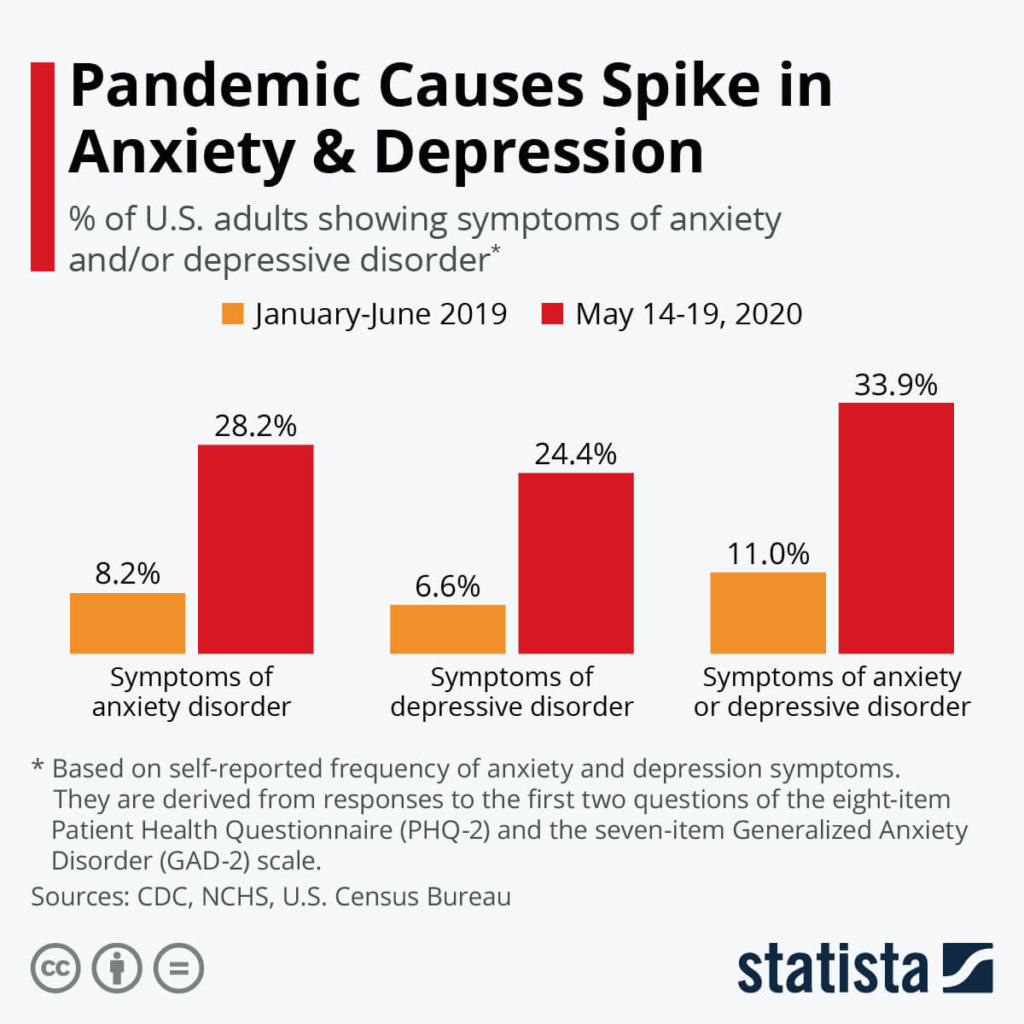
As the graph above depicts, rates of depression and anxiety have spiked significantly since Covid-19 emerged. The increase, coupled with the limitations necessary for the pandemic, makes telehealth a practical alternative for treatment.
Why Telehealth Works So Well for Depression and Anxiety
Telehealth services have quickly become the norm in the age of Coronavirus, out of necessity.One reasontelehealth platforms are the bomb is that they’re pandemic-proof. Here are some reasons why we should seek treatment for depression and anxiety online:
- More choices: Now, rather than searching “local therapists” and hoping to find a good fit within one’s community, we can Google “best counseling for stress online”or “online psychotherapy for mood disorders.” Just as we would check out our options for any other service or provision of goods, we can now do the same with our mental health needs.Telehealth has opened the doors ofchoice in mental health providers; it extends beyond the limitations of optimal driving distance and even state lines. Telehealth levels the playing field and gives clients with depression and anxiety, as well as other mental health needs, a say in who gets their business.
- Greater convenience and flexibility: Having access to therapywithin our homes during perilous times is not only convenient, but it is alsotimely, relevant, and compassionate. Whether it is because of a hellacious virus (and ensuing stay-at-home orders), a busy schedule, or childcare issues, telehealth meets us “where we’re at”. Literally.Since the pandemic began, 59% of people surveyed report a higher likelihood of using telemedicine than were previously willing.
- Depression and anxiety-friendly: Anyone who has struggled with depression or anxiety recognizes the intrinsic value of telehealth. Both of these conditions can make it exceedingly challenging to attend to daily life, particularly when symptoms flare up. Sometimesfatigue, social phobia,and other challenges prevent people from accessing services in clinics or traditional settings. The privacy and simplicity of online services make treatment more accessible for those struggling with internal barriers, and logistical issues like transportation.
- Confidentiality perks: Another advantage of telehealth for depression and anxiety is the added confidentiality that this format offers. While the stigma of accessing mental health treatment is waning, some people are still reluctant to obtain treatment in-person. People who are worried about being seen entering a conventional therapy setting are more inclined to use a telehealth format in which their needs are met in complete confidentiality.
Telehealth is an effective treatment method for anxiety and depression, and a variety of other mental health needs. Despite the way Covid-19 forced our systems to move ahead with the use of this technology, it certainly offers a wide array of benefits that will benefit us for years to come.